What is DTF Printing? A Complete Guide for UK Businesses
What is DTF Printing? A Complete Guide for UK Businesses
If you work in custom clothing, promotional products, or even custom patches here in the UK, you might have heard the term DTF printing. It stands for Direct-to-Film printing, and it’s one of the most talked-about printing methods in recent years.
Put simply, DTF printing is a way of applying a design to fabric by printing onto a special transfer film, coating it with an adhesive powder, and then using heat and pressure to bond it permanently to the material.
What makes it stand out is the versatility. Whether you want to decorate cotton, polyester, or blended fabrics, DTF works without needing expensive screen setups or limiting yourself to light-coloured garments. For small businesses, print-on-demand sellers, and UK companies producing uniforms or merchandise, it can be a cost-effective and reliable option.
What is DTF Printing?
Direct-to-Film printing is a process where your artwork is printed in full colour onto a PET transfer film using a specialist DTF printer. The printed film is coated with thermoplastic polyurethane (TPU) powder, which melts and fuses the ink to fabric when pressed with heat.
Unlike sublimation, which only works on polyester, or screen printing, which needs separate stencils for each colour, DTF printing allows you to create highly detailed, durable designs on many types of fabric. This makes it ideal for custom t-shirts, sportswear, caps, tote bags, and even embroidered patches that need a mixed decoration finish.
In short:
- Subject: DTF printing
- Predicate: works by transferring printed film with adhesive powder
- Object: onto fabric using a heat press
This is why many UK clothing brands and merch suppliers are adding it to their services.
How Does DTF Printing Work?
Although it sounds technical, the DTF process follows a few clear steps. Each stage is important because it affects the final print quality, durability, and colour accuracy.
Step 1: Preparing the Design and Film
The process starts with a digital design file, usually in PNG format with a transparent background. The design is printed onto a PET film using DTF inks, which include a layer of white ink to act as a base. This ensures colours stay vibrant, even on dark fabrics.
Step 2: Applying Adhesive Powder
While the ink is still wet, the printed film is coated with a fine adhesive powder. This powder is then melted slightly with heat so it sticks only to the inked areas, not the clear parts of the film. The adhesive is what makes the print bond strongly to the fabric.
Step 3: Heat Pressing the Fabric
The prepared film is placed onto the garment or patch, and a heat press applies both heat and pressure. The powder melts into the fibres, locking the ink into place. Depending on the fabric, the temperature usually ranges from 160°C to 170°C.
Step 4: Peeling and Post-Pressing
Once cooled slightly, the PET film is peeled away, leaving the print fixed on the fabric. To increase durability, many printers do a second press, which smooths the surface and helps the print last longer through washes.

Benefits of DTF Printing
Like any printing method, DTF comes with strengths that explain why it has gained such a following in the UK print and garment decoration scene.
Works on a Wide Range of Fabrics
Unlike sublimation, which is tied to polyester, or DTG, which works best on cotton, DTF can be applied to cotton, polyester, nylon, blends, denim, and more. This flexibility makes it especially useful for businesses that sell a mix of clothing and accessories.
Vibrant Colours and Fine Details
Because the design is first printed digitally on film, DTF can capture complex graphics, small text, gradients, and multiple colours without losing sharpness. The white underbase layer helps keep colours bold even on dark fabrics.
Strong Durability
When applied correctly, DTF prints are wash-resistant, stretchable, and less likely to crack or peel compared with some other print methods. For workwear, sports kits, or promotional apparel that needs to last, this reliability is a big plus.
Cost-Effective for Small Runs
Screen printing can be expensive for short orders because each colour requires a stencil. With DTF, you can print single items or short runs at a lower cost, which is perfect for UK start-ups, local clubs, and small clothing brands.
Smooth Workflow
DTF transfers can be printed in batches, stored, and then heat pressed onto fabric when needed. This flexibility helps printers reduce waste and manage orders more efficiently.
Limitations of DTF Printing
No print method is perfect, and DTF has a few drawbacks that businesses should weigh up before investing.
Initial Equipment Cost
For businesses wanting to print in-house, the cost of a professional DTF printer, curing equipment, and supplies can be high. While there are budget options, reliable results usually need a more serious setup.
Maintenance and Learning Curve
DTF printers require regular cleaning and maintenance to avoid issues such as clogged print heads. If neglected, this can lead to downtime and wasted materials.
Feel on Fabric
Unlike sublimation, which embeds colour into fibres, DTF prints sit on top of the fabric. Some people describe this as a slightly “plastic” feel, especially on lightweight garments.
Environmental Considerations
The process uses PET films and powders, which raises questions around sustainability and waste management. Some UK suppliers are now working on eco-friendlier options, but it’s something to keep in mind.
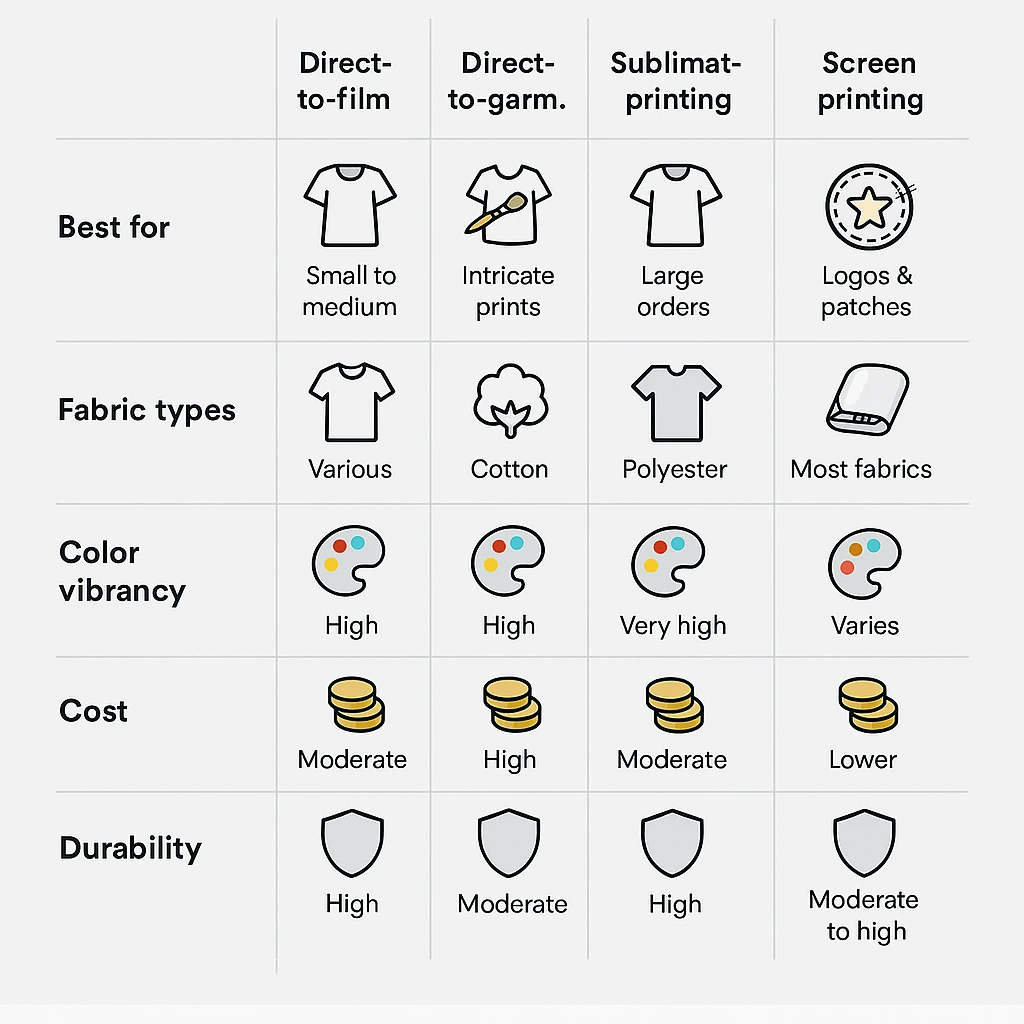
DTF Printing vs Other Print Methods
To see where DTF fits in, it’s useful to compare it with other popular techniques used in the UK.
DTF vs Screen Printing
- Screen Printing: Great for large orders, bold colours, and durability.
- DTF: Better for short runs, detailed designs, and multi-colour prints without extra setup.
Screen printing still wins for volume, but DTF is more flexible.
DTF vs Direct-to-Garment (DTG) Printing
- DTG: Prints directly onto the fabric with water-based inks. Works best on cotton.
- DTF: Prints on film first, then transfers. Works on many fabrics.
DTF often delivers stronger colour on dark garments and more versatility overall.
DTF vs Sublimation Printing
- Sublimation: Bonds ink into polyester fibres for a soft, permanent finish. Limited to light-coloured polyester fabrics.
- DTF: Bonds ink on top of fabric with adhesive, so it works on many textiles.
Sublimation is unbeatable for polyester sportswear, but DTF wins on variety.
DTF vs Embroidery
This is where your embroidery connection comes in.
- Embroidery: Adds a textured, high-end finish. Best for logos, uniforms, and items that need prestige and durability.
- DTF: Adds colourful, detailed designs that embroidery can’t replicate.
In many cases, businesses combine the two, embroidery for logos and DTF for decorative or promotional graphics.
What Can You Print with DTF?
One of the biggest strengths of DTF printing is just how many surfaces it can be applied to. It’s not limited to a single type of clothing, which makes it attractive for UK companies working across fashion, workwear, and merchandise.
Here are some of the most common uses:
- T-Shirts and Hoodies: Ideal for personalised gifts, retail brands, and promotional clothing.
- Workwear and Uniforms: DTF prints are strong enough to withstand regular washing, which is essential for uniforms.
- Sportswear: Great for custom numbers, names, and designs on polyester-based kits.
- Caps, Tote Bags, and Accessories: Because it bonds to a wide range of fabrics, DTF works for items beyond standard garments.
- Custom Patches: DTF can even be used alongside embroidery to create hybrid patches that mix texture with detailed prints. This is a clever way for UK businesses to stand out with something unique.
Is DTF Printing Right for Your Business?
DTF printing suits many situations, but whether it’s the right option depends on your goals.
It’s a good choice if:
- You want to offer a wide range of garments and accessories without being limited by fabric type.
- You need short-run printing for local clubs, events, or small clothing brands in the UK.
- You want prints with vivid colours and fine detail.
It may not be the best option if:
- You only work with high-volume orders (screen printing may be more efficient).
- You want a finish that is completely soft to the touch (sublimation or DTG can feel smoother).
- You prefer a luxury, textured look, where embroidery usually makes a stronger impression.
For many UK businesses, DTF doesn’t replace embroidery or screen printing, it works alongside them, offering another way to decorate garments and patches.
Frequently Asked Questions
Is DTF better than sublimation?
Not always. Sublimation is unbeatable for light polyester fabrics because the ink bonds directly with fibres, giving a soft feel. DTF is better for versatility since it works on cotton, polyester, and blends.
Is DTF better than DTG?
DTF is more flexible because it transfers onto different fabrics and gives bold colour on dark garments. DTG feels softer on cotton but doesn’t work as well on polyester.
How long do DTF prints last?
With proper application and care, DTF prints can last for 50+ washes without cracking or fading. Many UK printers also recommend a second press to extend durability.
Can DTF be combined with embroidery?
Yes, and this is where things get interesting. Embroidery gives a professional, stitched finish, while DTF allows detailed designs with colour gradients. Together, they can create eye-catching uniforms, patches, and branded products.
What fabrics does DTF not work on?
It struggles with heavily water-repellent or heat-sensitive fabrics, but works on most cotton, polyester, and blended materials.
Conclusion
DTF printing is becoming a real game-changer in the UK for businesses of all sizes. Its ability to deliver vibrant, detailed, and durable prints across a wide range of fabrics makes it ideal for t-shirts, hoodies, sportswear, and even accessories.
That said, it’s not a one-size-fits-all solution. For high-volume bulk runs, screen printing may still win. For a premium textured finish, embroidery is often the better choice. But when you need flexibility, colour range, and strong results on different textiles, DTF printing is hard to beat.
At Custom Embroidered Patches UK, we believe DTF and embroidery can complement each other beautifully. Whether you’re after a bold printed design, a stitched logo, or a mix of both, we help bring your ideas to life with quality and care.